Everyone keeps selling the same dumb AI fantasy:
“Your agent runs the whole business while you sip coffee and become a visionary.”
Yeah. Sure.
That fantasy is how you end up with a bot emailing the wrong lead, issuing a refund it should not issue, or confidently making a mess inside the exact systems that keep your company alive.
The better story, and the one that actually matters right now, is a lot less sexy on the surface:
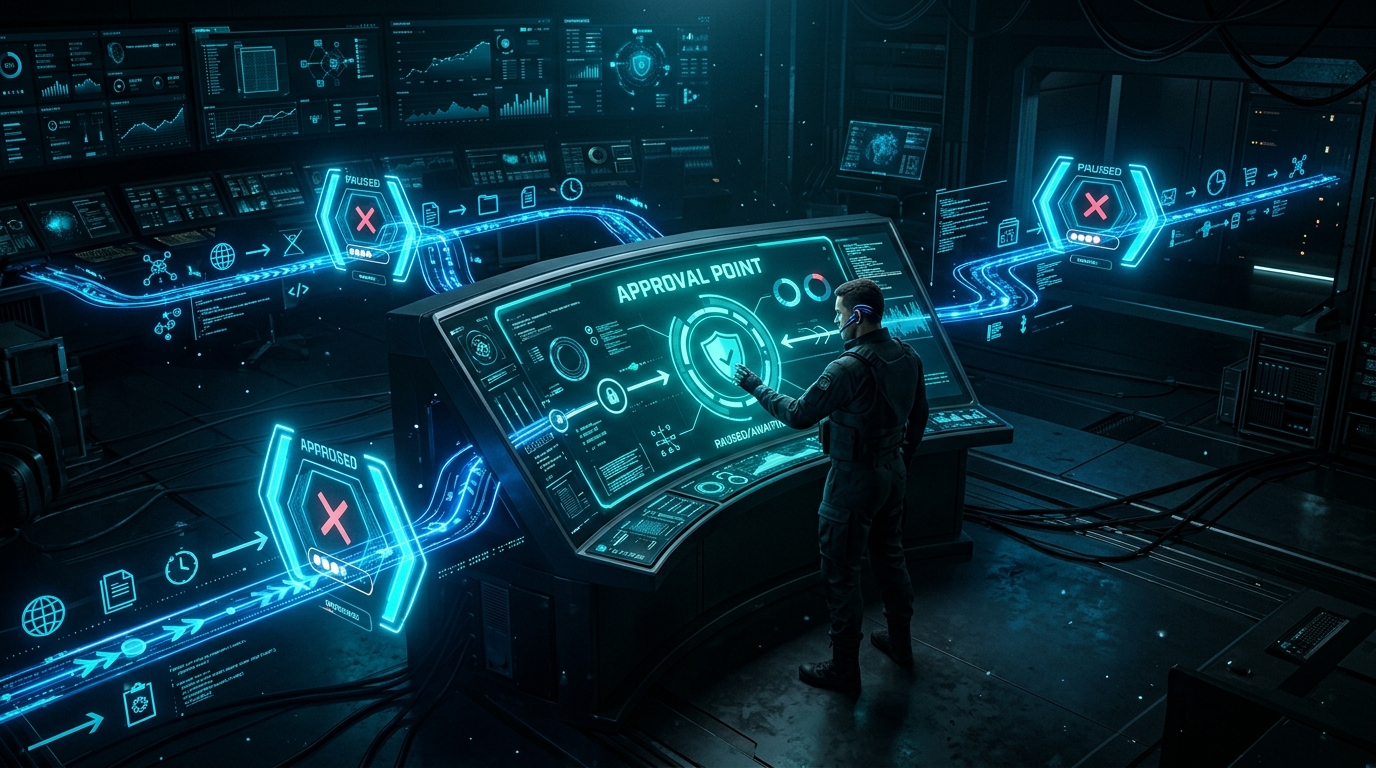
The best AI agent in your business is not fully autonomous. It is useful, fast, connected, and smart enough to stop at the right moment and ask for approval.
That is where the market is going, whether the hype boys like it or not.
Look at what happened in May 2026.
On May 13, 2026, Anthropic launched Claude for Small Business, a package of connectors and ready-to-run workflows that plugs Claude into tools like QuickBooks, PayPal, HubSpot, Canva, Google Workspace, and Microsoft 365. The most important line in the announcement was not the connector list. It was this operating model: Claude does the work, and you approve before anything sends, posts, or pays.
On May 11, 2026, OpenAI launched the OpenAI Deployment Company, built around forward-deployed engineers helping organizations redesign real workflows around AI systems that can reason, act, and produce measurable results. Translation: the serious money is moving away from prompt demos and toward operational systems.
Then on May 19, 2026, Google announced Search agents at I/O 2026, including background information agents and broader agentic task flows in Search.
Three different companies. Three different product surfaces. Same message.
Agents are growing up.
The real business agent is not a magic robot
Most business owners and operators do not need an “AI employee.”
They need a system that can:
- read across multiple tools
- do the annoying prep work
- recommend the next action
- execute the low-risk parts
- pause before the expensive, public, or irreversible step
That is the model.
Not autonomy for autonomy’s sake. Not a demo where the bot books a fake trip and everybody claps. Not some cursed LinkedIn post about how your company replaced six humans with a “digital worker.”
Business work has blast radius.
If an agent touches your cash flow, CRM, ad account, product catalog, customer inbox, pricing rules, or reporting layer, you do not want vibes. You want control.
That is why Anthropic’s small-business push is more important than another benchmark chart. It packages agentic workflows around actual business jobs like payroll planning, month-end close, invoice chasing, lead triage, and campaign prep. Those are not toy prompts. Those are repetitive operating tasks with enough structure to automate and enough risk to require oversight.
That is also why OpenAI’s deployment push matters. It is basically an admission that enterprises do not need another generic chatbot rollout. They need people and systems that can connect models to data, tools, controls, and business processes without turning the whole company into an experiment.
The approval gate is the product
Here is the part half the AI world still does not get:
The model is not the whole product.
The connector is not the whole product.
The agent framework is not the whole product.
The approval gate is a huge part of the product.
That gate decides whether an agent feels like a trusted operator or a chaos goblin.
If the agent drafts the campaign, segments the audience, pulls the ugly numbers, builds the creative direction, and then waits for a human thumbs-up before launch, that is useful.
If the agent quietly burns five grand on a bad promo because somebody wanted “full autonomy,” that is not innovation. That is just a faster idiot.
This is the practical difference between consumer AI theater and business AI systems:
- Consumer AI loves surprise.
- Business AI needs auditability.
That is why the strongest agent workflows are going to look boring in the best possible way. They will run in the background, handle prep, surface decisions, and ask at exactly the point where human judgment matters.
That is not a compromise. That is the design.
Where most teams will screw this up
A lot of companies are still approaching agents backward.
They start with the question, “What can the model do?”
Wrong question.
Start with:
“What step in this workflow is slow, repeatable, cross-system, and annoying enough that a human should stop doing it manually?”
That is where the wins are.
Good agent targets usually have four traits:
- The task hits multiple systems.
- The task repeats on a schedule or trigger.
- The task has a clear success condition.
- The final step benefits from approval.
Think about stuff like:
- compiling competitor pricing movement into a daily brief
- preparing product asset fixes before a catalog update
- drafting outbound campaigns from performance signals
- reconciling operational data before finance review
- monitoring brand, search, or retailer changes and routing the right alert
This is exactly why companies with clean operating data are about to pull away from everybody else.
If your source systems are a landfill, your agent becomes a very fast landfill raccoon.
If your product data, marketing assets, and monitoring flows are structured, the agent suddenly looks smart because the system around it is smart.
That is also where tools in the Tough Suite can help without pretending to be magic. If your team uses something like ToughMAP to monitor market behavior or ToughAssets to keep product content from drifting into garbage, you are giving agents cleaner surfaces to read from and act on. That matters way more than another “top 50 prompts” PDF ever will.
The next year of AI agents will be less flashy and more dangerous to lazy teams
That is the punchline.
The next wave of agents probably will not look like sci-fi. They will look like operators buried inside search, finance tools, CRMs, design apps, and internal workflows. They will summarize more, prep more, monitor more, and act more. And the companies that win will not be the ones screaming loudest about autonomy.
They will be the ones that build tight loops:
signal -> analysis -> proposed action -> approval -> execution -> audit trail
That loop is the future of business automation.
Not because it sounds cool, but because it actually survives contact with reality.
So if you are rolling out agents this summer, do yourself a favor:
Stop asking how human-free you can make the workflow.
Start asking where the human should stay in the loop, what the agent should prepare before that moment, and which systems need to be cleaned up so the agent is not working off nonsense.
That is how you get leverage without inviting disaster.
And that is the real tell from May 2026: the serious AI companies are no longer selling chat toys. They are building connected operators with guardrails.
Good.
That is the version of agentic AI businesses can actually use.